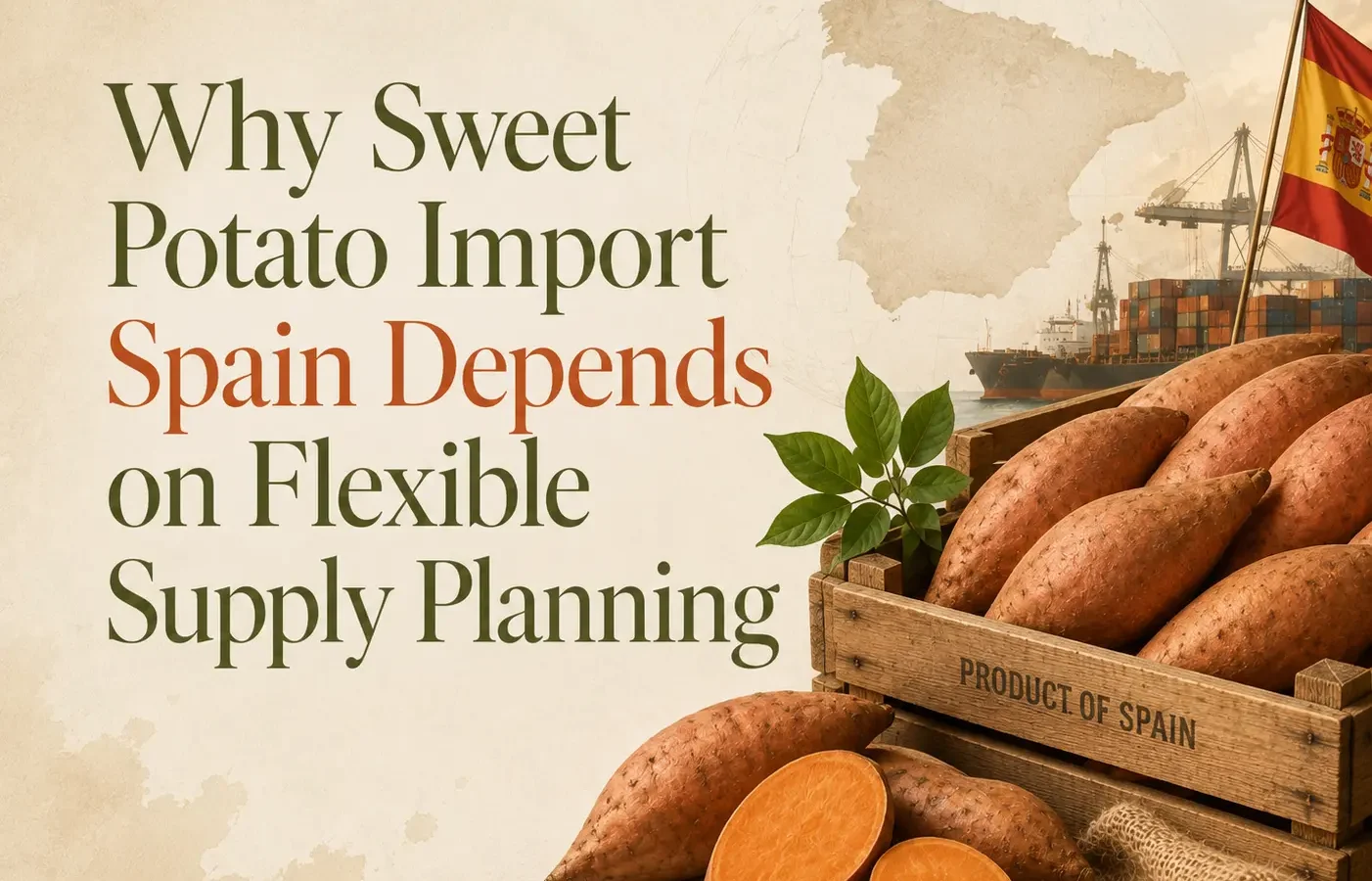
The role of sweet potato import Spain is not simply to replace domestic production. Spain has its own agricultural capacity, but buyers may still need imported supply when local availability, required grades, varieties, or commercial volumes do not fully match current demand. Flexible sourcing allows importers to use different origins strategically instead of depending on one harvest window throughout the year.
For companies operating in the sweet potato Spain market, the strongest sourcing strategy combines timing, quality, and product specifications. Current sweet potato import trends increasingly support this approach, with buyers comparing supply origins according to when products are available and how well they fit specific retail, wholesale, or food-service requirements. Understanding sweet potato growing conditions across different production regions can also explain why availability, sizing, and crop performance vary throughout the year.
Why Sweet Potato Import Spain Is About Complementing Supply
A successful sweet potato import Spain strategy does not need to treat imported and domestic products as competing options. In many cases, they can support different periods, specifications, or customer requirements within the same annual purchasing plan. For businesses in the sweet potato Spain market, imported supply can add flexibility when domestic availability is strong in one area but limited in another. This complementary approach is becoming increasingly visible in wider sweet potato import trends.
Imports and Domestic Production Can Serve Different Needs
Domestic production may work well for particular periods or commercial channels, while imported supply can become useful when buyers need additional grades, varieties, or volumes.
A flexible purchasing programme can help buyers respond to:
- Temporary volume shortages.
- Limited availability of specific sizes.
- Changes in buyer demand.
- Different variety requirements.
- Retail or food-service specifications.
- Seasonal shifts in product availability.
This is why understanding the sweet potato season across multiple origins matters. Different harvest calendars can give Spanish buyers more options without requiring them to abandon reliable local supply.
Filling Specific Availability Windows
Availability gaps are not always complete shortages. A market may still have sweet potatoes while lacking the exact commercial grade or volume a customer requires.
For sweet potato import Spain, the opportunity often appears when another origin can provide a useful supply window that complements what is already available domestically.
Why Import Opportunities Depend on Timing
Timing determines whether imported supply solves a real commercial need. An additional origin is most valuable when it enters the market at the right moment, with the right specifications, and without creating unnecessary oversupply.
This makes timing one of the most important factors shaping sweet potato import trends in the sweet potato Spain market.
What Sweet Potato Import Trends Reveal About Spanish Sourcing
Current sweet potato import trends show that buyers are becoming more flexible in how they select supply origins. Rather than relying entirely on one country or one harvest period, businesses increasingly compare seasonal availability, specifications, and supplier performance across several options. For sweet potato import Spain, this creates a sourcing model built around commercial fit rather than simple origin preference.
Greater Flexibility in Origin Selection
Different origins can contribute different advantages at different times. One region may provide strong availability during a particular month, while another may offer better access to a required grade or variety later in the season.
Origin flexibility can help buyers:
- Cover temporary availability gaps.
- Reduce dependence on one harvest.
- Compare different commercial specifications.
- Respond to unexpected demand.
- Plan supply over a longer period.
The 7 Nile Delta soil advantages help explain why Egypt can become one of these alternative origins, with agricultural conditions that can support commercial sweet potato production during useful supply periods.
Stronger Focus on Buyer Specifications
Importers are also becoming more specific about what they order. General descriptions are being replaced by clearer requirements for size, grade, skin quality, packing, and variety.
This is particularly important in the sweet potato Spain market, where retail, wholesale, and food-service buyers may each require different products.
Why Supply Continuity Is Becoming More Valuable
A single successful shipment can solve one short-term requirement, but buyers need continuity to build reliable purchasing programmes.
For sweet potato import Spain, suppliers that can communicate realistic availability and maintain agreed specifications may offer greater long-term value. This emphasis on continuity is becoming a defining feature of modern sweet potato import trends.
How Seasonality Shapes Sweet Potato Import Spain
Seasonality is one of the strongest influences on sweet potato import Spain because agricultural production naturally changes throughout the year. Domestic and international harvest periods do not always align, creating moments when buyers may need additional supply, different grades, or another sourcing origin. Understanding these seasonal movements helps businesses in the sweet potato Spain market plan more strategically instead of reacting only when shortages appear.
Understanding Changes in Market Availability
Supply changes as crops move from fresh harvest into storage and as one production region enters or leaves its main season. These shifts can influence both quantity and the type of commercial product available.
Buyers may notice changes in:
- Available sizes.
- Product freshness.
- Storage performance.
- Grade distribution.
- Variety availability.
- Market pricing.
Knowing when to harvest sweet potatoes in different origins helps buyers understand why supply quality and volume can change at different points in the year.
Identifying Commercial Supply Gaps
A commercial gap can exist even when sweet potatoes remain available. For example, buyers may have access to general stock but struggle to secure uniform retail sizes or a particular grade required by food service.
These gaps are an important part of sweet potato import trends because they show why total market volume alone does not tell the full sourcing story.
Planning Imported Volumes Around Demand
Importers should connect supply planning with actual customer demand rather than importing simply because another origin is available.
For sweet potato import Spain, the strongest programmes are built around clear seasonal needs. This allows imported supply to complement the sweet potato Spain market without creating unnecessary stock pressure.
What Buyers Need from Products Entering the Sweet Potato Spain Market
Products entering the sweet potato Spain market need to match the commercial requirements of the buyer, not simply meet a general definition of acceptable quality. In sweet potato import Spain, agreed specifications can determine whether a shipment moves smoothly into distribution or requires additional sorting and handling after arrival. This shift toward more precise product requirements is also reflected in current sweet potato import trends.
Uniform Commercial Grades
Uniform grading helps importers understand what they are buying before the shipment arrives. It also simplifies downstream distribution because products can be allocated more easily to the right customer.
Buyers may define:
- Size ranges.
- Shape requirements.
- Commercial grade.
- Acceptable surface defects.
- Product uniformity.
- Variety.
A strong quality control process helps identify products that fall outside agreed specifications before they are packed for export.
Freshness and Shelf-Life Performance
Freshness matters at arrival, but buyers also need sufficient time to distribute and sell the product afterward.
Good commercial performance includes:
- Firm roots.
- Healthy skin.
- Stable product condition.
- Suitable storage potential.
- Enough remaining selling time.
These factors are particularly important for sweet potato import Spain because product value continues to change after the shipment reaches its destination.
Product Specifications for Different Sales Channels
Retailers, wholesalers, processors, and food-service customers may all define quality differently.
The sweet potato Spain market therefore benefits when buyers communicate the intended use before ordering. This supports sweet potato import trends toward more precise, channel-specific sourcing rather than one general specification for every customer.
How Food Service Influences Sweet Potato Spain Demand
Food-service businesses add another layer of demand to the sweet potato Spain market because restaurants, caterers, and commercial kitchens often evaluate products differently from retailers. For sweet potato import Spain, meeting food-service requirements may involve reliable sizing, predictable cooking behaviour, and consistent supply over repeated orders. These priorities are expanding the way buyers interpret modern sweet potato import trends.
Reliable Sizing for Kitchen Operations
Uniform sizing can improve efficiency in professional kitchens. Roots that are reasonably consistent are easier to portion, prepare, and cook at similar rates.
Food-service buyers may prioritise:
- Predictable portion sizes.
- Consistent root dimensions.
- Efficient preparation.
- Reduced trimming waste.
- Reliable carton composition.
A jumbo sweet potato may work well for particular applications, while other kitchens may prefer medium or smaller roots for easier portion control.
Texture and Cooking Performance
The way a sweet potato behaves after cooking can be just as important as how it looks before preparation. Different varieties may vary in sweetness, moisture, and firmness.
Food-service buyers therefore need to consider whether products are suitable for:
- Roasting.
- Baking.
- Frying.
- Mashing.
- Pureeing.
- Large-scale preparation.
Maintaining Consistency Across Repeat Orders
Restaurants and catering businesses need predictable ingredients if they want to maintain the same menu quality over time.
For sweet potato import Spain, repeat consistency can therefore influence supplier value. The sweet potato Spain food-service market benefits from suppliers that can maintain similar specifications rather than changing sizes or grades unpredictably, a priority increasingly visible in sweet potato import trends.
Why Packaging Matters in Sweet Potato Import Spain
Packaging directly affects how well sweet potato import Spain performs during transportation and after arrival. Sweet potatoes may pass through loading, international transit, warehouses, wholesalers, and final distribution before reaching their customer. In the sweet potato Spain market, packaging therefore needs to support both product protection and efficient commercial handling. Its growing importance is also reflected in broader sweet potato import trends.
Protecting Products During Transit
Movement, pressure, and repeated handling can damage roots during transport. Packaging needs enough strength to protect the crop while avoiding unnecessary compression.
Professional sweet potato packaging solutions can help:
- Limit movement inside cartons.
- Reduce bruising.
- Support stable stacking.
- Protect skin quality.
- Maintain shipment presentation.
Good packaging protects the commercial value created before the product ever enters transport.
Efficient Handling After Arrival
Packaging also affects what happens once the shipment reaches Spain. Cartons need to move efficiently through warehouses and distribution systems without creating unnecessary repacking or handling.
Important factors include:
- Practical carton weights.
- Pallet stability.
- Clear labelling.
- Easy product inspection.
- Compatibility with customer operations.
For sweet potato import Spain, this operational efficiency can reduce work after arrival and make imported supply easier to integrate into existing systems.
Packaging for Retail, Wholesale, and Food Service
Different channels may require different packaging formats. Retail buyers may prioritise presentation, wholesalers may focus on durability, and food-service distributors may prefer formats designed for efficient commercial handling.
Adapting packaging to the final customer supports the sweet potato Spain market more effectively and reflects sweet potato import trends toward buyer-specific supply solutions.
How Buyers Compare the Real Cost of Imported Supply
The true commercial cost of sweet potato import Spain cannot be measured by purchase price alone. Buyers also need to consider how much product remains saleable, how long it can stay in distribution, and whether additional sorting or repacking is required after arrival. In the sweet potato Spain market, evaluating these wider costs gives importers a more accurate picture of supplier value and follows sweet potato import trends toward total-performance sourcing.
Product Price Versus Saleable Yield
Two shipments with similar volumes can deliver very different financial outcomes if one contains more damaged, unsuitable, or inconsistent products.
Buyers should compare:
- Total purchased volume.
- Saleable volume after inspection.
- Product losses.
- Regrading requirements.
- Remaining shelf life.
- Final revenue potential.
Sourcing farm fresh sweet potatoes that maintain their quality throughout distribution can create greater commercial value even when the starting quotation is not the lowest.
The Commercial Cost of Waste
Waste affects more than the value of discarded roots. It can also increase labour, disposal, storage, and inventory-management costs.
For sweet potato import Spain, high product loss can quickly erase any initial price advantage and reduce profitability across the shipment.
Why Shipment Reliability Influences Value
Reliability allows buyers to plan purchasing, inventory, and customer commitments with greater confidence. A supplier that consistently meets specifications and delivery expectations can reduce operational uncertainty.
This is why sweet potato import trends increasingly favour dependable performance over one-off bargains. For buyers serving the sweet potato Spain market, reliable shipments can create more value over time than repeatedly choosing the cheapest available offer.
How Sweet Potato Import Trends Are Changing Buyer-Supplier Relationships
Current sweet potato import trends are encouraging buyers to build more structured relationships with suppliers instead of treating every order as a separate transaction. In sweet potato import Spain, this means clearer specifications, more visibility around expected availability, and greater attention to repeat performance. For companies operating in the sweet potato Spain market, these changes can reduce uncertainty and make seasonal sourcing easier to manage.
More Detailed Pre-Order Specifications
Buyers increasingly want to define the product before shipment preparation begins. This helps avoid misunderstandings about grade, sizing, appearance, or packing after the order is already in progress.
Pre-order specifications may include:
- Variety.
- Size range.
- Commercial grade.
- Skin condition.
- Acceptable tolerances.
- Packing format.
- Expected shipment timing.
For buyers comparing different varieties of sweet potatoes, agreeing on these details early makes it easier to match the selected product with the intended market.
Greater Demand for Supply Visibility
Importers also want clearer information about what is available and when. Agricultural supply can shift throughout the season, so visibility around harvest timing, expected volumes, and possible changes becomes commercially valuable.
For sweet potato import Spain, better visibility helps buyers plan stock levels and customer commitments before a shortage develops.
Repeat Performance Over One-Off Deals
One strong order can build interest, but repeat performance builds confidence. In the sweet potato Spain market, buyers increasingly value suppliers that can maintain similar quality and specifications across multiple shipments.
This shift reflects broader sweet potato import trends toward more dependable, long-term supplier relationships.
Why Multiple Origins Can Strengthen the Sweet Potato Spain Supply Chain
Using more than one production origin can make the sweet potato Spain supply chain more flexible and resilient. Different growing regions offer different harvest windows, commercial characteristics, and supply strengths, which means sweet potato import Spain can be planned around actual buyer needs rather than dependence on one origin alone. This approach is increasingly visible in modern sweet potato import trends.
Creating More Flexible Seasonal Coverage
Different countries do not reach harvest at exactly the same time. Buyers can use these seasonal differences to maintain supply across a longer period and reduce pressure during tighter market windows.
A multi-origin strategy can support:
- Broader seasonal coverage.
- More stable availability.
- Additional commercial grades.
- Better response to demand peaks.
- Greater purchasing flexibility.
The Egyptian sweet potato heritage is relevant here because long-standing production experience can support Egypt’s role as one of several sourcing origins available to international buyers.
Reducing Dependency on One Harvest
Relying heavily on one crop or region can expose buyers to weather, harvest delays, or unexpected shortages.
For sweet potato import Spain, additional origins can reduce that risk and give buyers more options if availability changes suddenly.
Matching Origins with Different Buyer Needs
Not every origin needs to serve the same purpose. One may be useful for a particular variety, another for a stronger seasonal window, and another for a specific grade or commercial format.
This flexibility allows the sweet potato Spain market to benefit from a more balanced sourcing strategy instead of forcing one supplier to meet every requirement.
Where Egyptian Supply Fits into Sweet Potato Import Spain
Egyptian production can complement sweet potato import Spain by giving buyers another seasonal option with commercial export experience. The role of Egyptian supply is not necessarily to replace existing sources, but to strengthen the wider sweet potato Spain market when additional volumes, grades, or supply timing are needed. This fits with sweet potato import trends that increasingly favour diversified sourcing.
Complementing Existing Market Supply
Imported products can add value when they solve a specific sourcing problem. Egyptian supply may be relevant when buyers need:
- Additional seasonal volumes.
- Alternative commercial grades.
- More sourcing flexibility.
- Retail or wholesale continuity.
- A second origin for risk management.
These benefits can help importers create a broader supply programme rather than depending on a single seasonal window.
Seasonal Availability from Egypt
Egypt’s production calendar can offer useful timing for international buyers. Suitable climate and growing conditions can support commercially relevant supply periods for European markets.
Buyers can also explore Egyptian sweet potato benefits when comparing how origin, freshness, seasonality, and export suitability may support their sourcing strategy.
Export Preparation for Spanish Buyers
A good crop still needs to be prepared correctly for international distribution. Grading, packing, documentation, and transport coordination all influence how well products arrive.
For sweet potato import Spain, this preparation is essential because buyers in the sweet potato Spain market expect products that can move efficiently into their own distribution channels after arrival.
What Spanish Buyers Should Confirm Before Importing
Before starting a new sweet potato import Spain programme, buyers should confirm the product specification, seasonal capacity, and practical export process in detail. Clear preparation reduces uncertainty and helps businesses in the sweet potato Spain market compare suppliers more objectively. Current sweet potato import trends increasingly favour buyers who define requirements before the shipment enters preparation.
Available Grades and Varieties
Importers should confirm exactly what is available during the planned shipment period.
Important questions include:
- Which varieties can be supplied?
- What sizes are available?
- How are commercial grades defined?
- What quality tolerances apply?
- Can the same specification be repeated?
Reviewing our sweet potato products can help buyers compare available options before choosing the most suitable product for their customers.
Volume and Seasonal Capacity
A supplier should be able to explain what volumes can realistically be maintained throughout the season.
Buyers need to know whether the supplier can support:
- Trial shipments.
- Repeat commercial orders.
- Seasonal programmes.
- Increased demand.
- Planned future volumes.
Packaging, Documentation, and Logistics
The operational process also matters. Buyers should understand how products are packed, documented, scheduled, and coordinated for shipment.
For sweet potato import Spain, these details can affect arrival quality and determine how smoothly products enter the sweet potato Spain distribution system.
How Farm Sweet Supports Sweet Potato Import Spain
Farm Sweet supports sweet potato import Spain by combining commercial production, grading, packing, and export coordination into one structured process. Buyers serving the sweet potato Spain market need consistency, clear specifications, and realistic seasonal planning, not simply available products. These expectations align with modern sweet potato import trends, where supplier reliability is measured across the full supply process.
Commercial Egyptian Sweet Potatoes
Our production is managed with commercial requirements in mind from the field through post-harvest handling.
We focus on:
- Suitable commercial varieties.
- Healthy product condition.
- Consistent sizing.
- Reliable grading.
- Seasonal availability.
Buyers can also explore Beauregard sweet potatoes when comparing varieties for different commercial uses and market expectations.
Flexible Packing and Grading
Different buyers may need different sizes, grades, or packing formats. Farm Sweet works to clarify these requirements before products enter final preparation.
This can support:
- Retail programmes.
- Wholesale distribution.
- Food-service supply.
- Buyer-specific grading.
- Different packaging formats.
Reliable Export Coordination
Reliable supply depends on more than production. Buyers also need clear communication about availability, shipment preparation, and expected timing.
For sweet potato import Spain, structured coordination can help customers in the sweet potato Spain market plan repeat orders with greater confidence.
Final Thoughts: Flexible Sourcing Creates Better Supply Options
A strong sweet potato import Spain strategy is built around flexibility rather than dependence on one origin, one harvest window, or one supplier. Buyers gain more control when they understand how different origins can complement each other and where each one adds the most commercial value.
Within the sweet potato Spain market, better sourcing decisions also depend on clear specifications, reliable communication, consistent quality, and realistic seasonal planning. These priorities are becoming increasingly important in sweet potato import trends because they help buyers reduce supply risk while protecting product performance.
Working with an experienced Egyptian sweet potato exporter can add another useful sourcing option for buyers looking for seasonal flexibility, professional grading, and export-ready preparation.
Ultimately, flexible sourcing creates stronger supply options when each origin has a clear role. For companies managing sweet potato import Spain, that approach can support more stable availability, better product matching, and a more resilient position in the evolving sweet potato Spain market.
FAQs: Flexible Sourcing for the Sweet Potato Spain Market
- Why is sweet potato import Spain useful when Spain produces sweet potatoes?
Imports can complement domestic production by providing additional volumes, specifications, varieties, or supply during periods when buyers need greater flexibility.
- What sweet potato import trends are influencing Spain?
Sweet potato import trends include more flexible origin selection, stronger quality specifications, supply diversification, and greater focus on repeat reliability.
- What do buyers expect in the sweet potato Spain market?
Buyers may look for uniform grading, freshness, suitable sizing, shelf life, professional packaging, and dependable commercial supply.
- How does seasonality affect sweet potato import Spain?
Seasonal changes can create periods when imported supply helps buyers maintain availability or meet requirements not fully covered by current domestic production.
- How can Egypt support the sweet potato Spain market?
Egypt can complement Spanish supply through seasonal availability, export-quality products, flexible specifications, and professional shipment preparation.