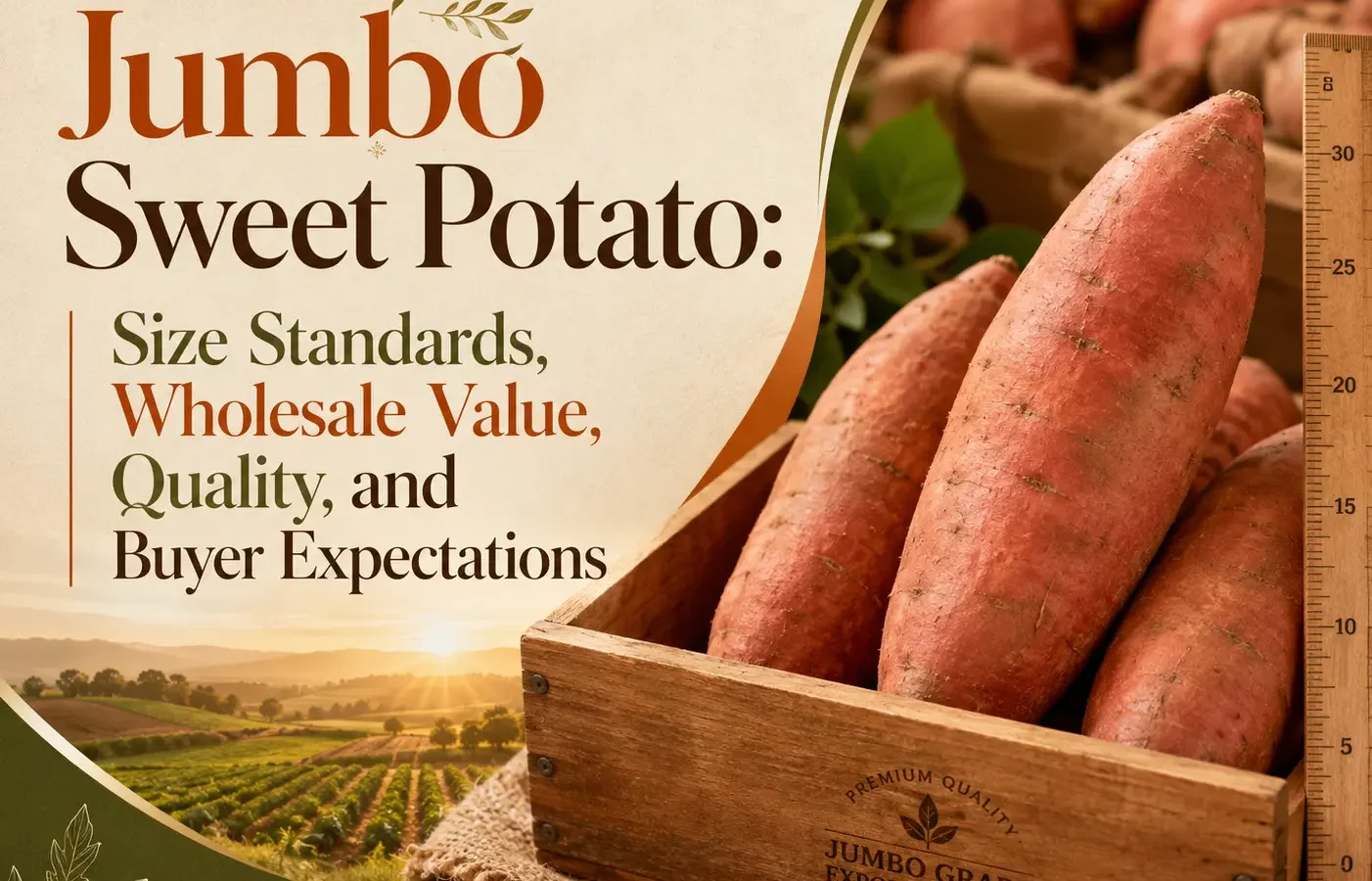
A jumbo sweet potato may look impressive, but size alone does not guarantee commercial value. Buyers also examine shape, skin quality, freshness, texture, storage performance, and consistency across each order.
For wholesalers and retailers, the most important questions are:
- What qualifies as a jumbo size?
- Does the crop remain fresh during storage?
- Are the roots uniform enough for packing and display?
- Can the supplier deliver the same quality consistently?
- Does the price reflect the product’s actual condition?
These factors become especially important when sourcing wholesale sweet potatoes, where one poor shipment can lead to waste, complaints, and lower profits.
The quality of farm fresh sweet potatoes begins in the field but must also be protected through harvesting, grading, packaging, storage, and transportation.
This guide explains what defines a jumbo sweet potato, how buyers assess its quality and wholesale value, and what businesses should check before placing an order.
What Defines a Jumbo Sweet Potato?
Not every large sweet potato qualifies as a jumbo sweet potato. In commercial agriculture, buyers evaluate more than size alone. Weight, shape, uniformity, skin quality, and overall condition all influence whether a sweet potato meets wholesale standards. A root that is unusually large but misshapen or damaged may have less market value than a slightly smaller one with a consistent appearance. This is why growers and buyers use a combination of grading standards rather than relying on size alone, particularly when sourcing wholesale sweet potatoes.
How Jumbo Sweet Potatoes Are Classified by Size and Weight
Although sizing standards may differ between buyers and markets, jumbo sweet potatoes are generally identified by their larger dimensions and heavier weight compared with standard grades.
Commercial grading often considers:
- Root length
- Root diameter
- Individual weight
- Overall appearance
- Consistency within the shipment
These characteristics help buyers source farm fresh sweet potatoes that meet their specific market requirements.
Why Shape and Uniformity Matter Alongside Size
Large roots are valuable only when they are also uniform and visually appealing. Consistent sizing simplifies grading, packaging, transportation, and retail display while improving customer satisfaction.
Buyers typically prefer jumbo sweet potatoes that offer:
- Smooth skin
- Uniform shape
- Even sizing
- Minimal surface defects
- Strong overall appearance
The Difference Between Naturally Large Roots and Overgrown Crops
A naturally developed jumbo sweet potato depends on suitable sweet potato growing conditions, the right varieties, and proper field management throughout the season. In contrast, overgrown roots may become irregular in shape, develop rough skin, or lose some of the characteristics buyers expect.
For suppliers of wholesale sweet potatoes, producing naturally large, high-quality roots is far more valuable than simply growing the biggest crop possible. The goal is to deliver farm fresh sweet potatoes that combine size with consistency, appearance, and reliable commercial performance.
Why Jumbo Sweet Potato Demand Is Growing
Demand for jumbo sweet potato products has increased as more retailers, food-service businesses, and food manufacturers look for products that combine efficiency with consistent quality. Larger sweet potatoes often provide better value for commercial operations because they reduce preparation time, simplify portioning, and meet the expectations of customers looking for premium produce. At the same time, buyers of wholesale sweet potatoes continue to prioritize uniformity, freshness, and reliable supply over size alone.
How Retail and Food-Service Buyers Use Larger Sweet Potatoes
Different industries use jumbo sweet potatoes in different ways, depending on their operational needs.
Common applications include:
- Retail displays featuring premium-sized produce
- Restaurants serving baked or stuffed sweet potatoes
- Hotels and catering services
- Food manufacturing and processing
- Wholesale distribution
When sourced correctly, farm fresh sweet potatoes help businesses maintain consistent quality while reducing product waste.
Why Large Roots Can Improve Portioning and Processing Efficiency
Larger roots can improve efficiency across commercial operations. Fewer individual sweet potatoes are needed to achieve target portions, making preparation faster and more consistent.
This can help businesses:
- Reduce preparation time
- Improve portion consistency
- Increase processing efficiency
- Simplify inventory management
- Reduce labour costs
These advantages make jumbo sweet potato products an attractive choice for many commercial buyers.
Consumer Preferences That Influence Jumbo Sweet Potato Sales
Consumers are increasingly attracted to sweet potatoes that offer both visual appeal and reliable quality. Large, uniform roots often create a stronger impression, especially when they have smooth skin and a fresh appearance.
For suppliers, growing sweet potatoes for these markets means focusing on the combination of size, consistency, and quality that buyers and consumers expect rather than simply producing the largest roots possible.
The Growing Conditions Behind High-Quality Jumbo Sweet Potatoes
Producing a premium jumbo sweet potato starts long before harvest. Large, high-quality roots develop when the crop grows under favourable conditions throughout the season. Soil structure, moisture levels, nutrient availability, and variety selection all influence root size and overall quality. Growers who manage these factors carefully are more likely to produce farm fresh sweet potatoes that meet the standards expected by buyers of wholesale sweet potatoes.
Why Loose Soil Supports Larger Root Development
Sweet potatoes expand beneath the soil, so they require enough space to develop naturally. Loose, well-drained soil encourages healthy root growth while reducing the risk of misshapen or damaged roots. These characteristics are also among the 7 Nile Delta soil advantages that make the region well suited to commercial sweet potato production.
Healthy soil helps:
- Promote uniform root expansion
- Improve water movement
- Support nutrient uptake
- Reduce root deformation
- Produce larger, more consistent crops
How Moisture and Nutrition Influence Root Size
Consistent irrigation and balanced nutrition allow sweet potatoes to grow steadily throughout the season. Too much or too little water can limit root development, while nutrient imbalances may reduce crop quality.
Well-managed crops often benefit from:
- Stable moisture levels
- Healthy plant growth
- Better root sizing
- Improved crop consistency
- Stronger harvest quality
These practices help growers produce jumbo sweet potato crops with better commercial value.
Why Variety Selection Matters for Jumbo Production
Not every variety is capable of producing large, uniform roots. Choosing varieties with strong growth potential is an important step for growers targeting premium markets. Some varieties naturally develop larger roots while maintaining good shape, texture, and storage performance.
When suitable varieties are combined with proper field management, growers can consistently supply wholesale sweet potatoes and farm fresh sweet potatoes that satisfy buyer expectations for both size and quality.
Jumbo Size Versus Quality: What Buyers Should Check
While a jumbo sweet potato may attract attention because of its size, experienced buyers know that quality is what determines its true commercial value. A large root with poor shape, damaged skin, or internal defects is often less desirable than a slightly smaller one with excellent overall quality. This is why buyers of wholesale sweet potatoes evaluate several characteristics before making purchasing decisions. The best farm fresh sweet potatoes combine impressive size with consistency, freshness, and excellent condition.
Why Bigger Does Not Always Mean Better
Large sweet potatoes are valuable only when they meet commercial quality standards. Oversized roots that are irregular or damaged may be difficult to pack, transport, or sell.
Professional buyers usually assess:
- Uniform size
- Well-balanced shape
- Smooth skin
- Consistent appearance
- Overall freshness
A high-quality jumbo sweet potato should offer both size and market-ready presentation.
Signs of Strong Skin, Texture, and Internal Quality
Healthy sweet potatoes should maintain their quality from harvest through delivery. At Farm Sweet, our quality standards focus on the characteristics that matter to commercial buyers, from external appearance and firmness to consistency and overall product condition.
Key quality indicators include:
- Smooth, undamaged skin
- Firm texture
- Uniform colour
- Clean surface
- Good storage potential
These qualities help ensure that farm fresh sweet potatoes perform well throughout the supply chain.
Common Defects That Can Reduce Commercial Value
Even large sweet potatoes can lose value if they develop defects during growth, harvest, or storage. Identifying these issues early helps buyers receive more consistent shipments.
Common quality concerns include:
- Misshapen roots
- Surface bruising or cuts
- Skin blemishes
- Cracks or splits
- Uneven sizing within the shipment
For suppliers of wholesale sweet potatoes, maintaining consistent quality is just as important as producing a large jumbo sweet potato. Buyers are far more likely to build long-term relationships with growers who consistently deliver products that meet both size and quality expectations.
How Farm Fresh Sweet Potatoes Maintain Better Market Appeal
Freshness is one of the first qualities buyers notice when evaluating a jumbo sweet potato. Bright appearance, firm texture, and healthy skin all influence purchasing decisions, especially in competitive retail and wholesale markets. However, these qualities are not preserved by chance. They result from careful harvesting, proper handling, and suitable storage conditions. For suppliers of wholesale sweet potatoes, maintaining freshness helps reduce waste, improve customer satisfaction, and strengthen long-term business relationships.
Why Freshness Influences Texture and Appearance
Freshly harvested sweet potatoes are more likely to retain the qualities buyers expect. Good freshness contributes to both visual appeal and eating quality.
Buyers often look for:
- Smooth, healthy skin
- Firm texture
- Uniform colour
- Clean appearance
- Consistent product quality
These characteristics help farm fresh sweet potatoes stand out in both retail displays and wholesale shipments.
The Importance of Harvest Timing for Larger Roots
Understanding how to farm sweet potatoes for commercial markets also means knowing when the crop has reached the right stage for harvest. Harvesting too early may affect root development, while delaying harvest can increase the risk of damage or reduced storage performance.
Harvesting at the right stage helps:
- Preserve root quality
- Improve shelf life
- Reduce harvest damage
- Maintain consistent sizing
- Increase market value
How Careful Handling Protects Farm Fresh Sweet Potatoes
Quality can be lost quickly if sweet potatoes are handled roughly after harvest. Proper grading, sorting, and transportation help protect the crop until it reaches the buyer.
For suppliers of wholesale sweet potatoes, careful handling is essential for delivering farm fresh sweet potatoes that maintain their appearance, freshness, and commercial value from the field to the final market.
What Wholesale Buyers Expect from Jumbo Sweet Potatoes
Purchasing wholesale sweet potatoes is about far more than ordering large quantities. Buyers expect every shipment to meet consistent standards for size, quality, freshness, and presentation. Whether supplying supermarkets, food-service businesses, or distributors, consistency helps reduce waste, simplify inventory management, and build customer confidence. For suppliers, producing a premium jumbo sweet potato means delivering reliable quality in every order, not just in a single shipment.
Uniform Sizing and Grading Requirements
Consistent grading allows buyers to process, display, and sell sweet potatoes more efficiently. Uniform shipments also make packaging and pricing easier across different markets.
Wholesale buyers typically look for:
- Consistent root size
- Uniform shape
- Smooth, healthy skin
- Minimal defects
- Accurate grading
These standards help ensure that farm fresh sweet potatoes arrive ready for immediate distribution or retail display.
Reliable Supply Across Multiple Shipments
Many commercial buyers require dependable supply throughout the season rather than occasional deliveries. Well-planned sweet potato farming helps suppliers coordinate production and harvest volumes more effectively, allowing buyers to plan inventory, meet customer demand, and maintain stable operations.
Reliable suppliers are expected to provide:
- Consistent product quality
- Stable seasonal availability
- Predictable shipment schedules
- Clear communication
- Professional order fulfilment
Packaging and Presentation Standards for Wholesale Markets
Proper packaging helps protect sweet potatoes while improving their presentation upon arrival. Well-packed shipments reduce the risk of bruising and make handling more efficient throughout the supply chain.
For suppliers of wholesale sweet potatoes, combining professional packaging with consistent grading helps ensure every jumbo sweet potato reaches the buyer in excellent condition. Delivering clean, well-presented farm fresh sweet potatoes strengthens buyer confidence and supports long-term commercial partnerships.
How Wholesale Sweet Potatoes Are Priced
The price of wholesale sweet potatoes is influenced by much more than the size of the crop. Buyers evaluate several factors before determining whether a shipment offers good value, including variety, quality, freshness, grading, and storage performance. A premium jumbo sweet potato that meets commercial standards is often worth more than a larger root with poor appearance or inconsistent quality. Understanding how these factors affect pricing helps both growers and buyers make better commercial decisions.
The Role of Size, Variety, Season, and Quality
Wholesale prices are usually based on a combination of characteristics rather than a single feature. Variety can also influence buyer preferences, with products such as Beauregard sweet potatoes offering specific characteristics for different commercial markets. While larger roots may command higher prices in some cases, quality remains a deciding factor.
Pricing is commonly influenced by:
- Root size and grading
- Sweet potato variety
- Seasonal availability
- Skin condition and appearance
- Overall crop quality
High-quality farm fresh sweet potatoes that consistently meet buyer expectations are generally more competitive in commercial markets.
Why Storage Performance Affects Commercial Pricing
Sweet potatoes that maintain their quality during storage and transportation often provide greater value for buyers. Strong storage performance reduces losses and helps products arrive in excellent condition.
Good storage performance can lead to:
- Lower product waste
- Better shelf life
- Improved transport reliability
- Higher customer satisfaction
- Greater commercial value
How Buyers Compare Value Without Sacrificing Quality
Experienced buyers look beyond the lowest price when sourcing wholesale sweet potatoes. They consider whether a supplier can consistently deliver quality, reliability, and market-ready products.
When evaluating a jumbo sweet potato, buyers often compare:
- Product consistency
- Freshness and appearance
- Packaging quality
- Supply reliability
- Overall value rather than price alone
For many businesses, investing in premium farm fresh sweet potatoes delivers better long-term value than choosing lower-priced products that fail to meet commercial quality standards.
Packaging Jumbo Sweet Potatoes for Storage and Transport
Packaging is an essential step in preserving the quality of a jumbo sweet potato after harvest. Because larger roots are heavier and occupy more space, they require careful packing to reduce movement and prevent damage during storage and transportation. Well-designed packaging helps maintain freshness, protects appearance, and ensures that wholesale sweet potatoes arrive in excellent condition. For buyers, proper packaging is often a sign of a supplier’s commitment to quality and professionalism.
Why Larger Roots Require Careful Packing
Jumbo sweet potatoes place more pressure on one another during transport than standard-sized roots. Without suitable packaging, they are more likely to develop bruises, cuts, or skin damage.
Effective packing helps:
- Reduce unnecessary movement
- Protect the skin from damage
- Maintain product appearance
- Improve storage performance
- Preserve commercial quality
These practices help ensure that farm fresh sweet potatoes reach buyers in market-ready condition.
Reducing Bruising and Pressure Damage During Shipping
Transportation exposes sweet potatoes to vibration, stacking pressure, and repeated handling. Proper packing methods help minimise these risks throughout the supply chain.
To reduce damage, suppliers often focus on:
- Secure product placement
- Appropriate carton strength
- Careful stacking procedures
- Gentle loading and unloading
- Consistent handling practices
Choosing Packaging Formats for Different Buyer Needs
Different markets often require different packaging formats depending on their operations, distribution methods, and the variety being supplied. Buyers sourcing products such as Bellevue sweet potatoes may also have specific requirements for sizing, presentation, and packing based on how the product will be distributed.
For suppliers of wholesale sweet potatoes, selecting the right packaging helps protect every jumbo sweet potato while improving handling efficiency and product presentation. Combined with careful harvesting and storage, professional packaging allows farm fresh sweet potatoes to maintain their quality from the farm to the final destination.
Storage and Shelf-Life Expectations for Jumbo Sweet Potatoes
Maintaining the quality of a jumbo sweet potato does not end after harvest. Proper storage is essential for preserving freshness, appearance, and texture until the product reaches the buyer. Without suitable storage conditions, even high-quality roots can lose moisture, develop skin damage, or experience a shorter shelf life. For suppliers of wholesale sweet potatoes, effective storage practices help reduce losses while ensuring consistent quality across every shipment.
How Curing Strengthens Skin and Supports Storage
Curing is one of the first steps after harvest and plays an important role in preparing sweet potatoes for storage. It allows the skin to strengthen while reducing the risk of moisture loss and minor surface damage.
The curing process helps:
- Strengthen the outer skin
- Reduce moisture loss
- Improve storage performance
- Protect against minor handling damage
- Extend marketability
The Role of Temperature, Humidity, and Airflow
After curing, sweet potatoes should be stored under controlled conditions to preserve their quality. Stable storage environments help maintain freshness and reduce the risk of deterioration.
Good storage management focuses on:
- Appropriate temperature
- Balanced humidity
- Adequate airflow
- Clean storage facilities
- Regular product monitoring
These conditions help keep farm fresh sweet potatoes in excellent condition throughout storage and transportation.
Why Shelf Life Matters to Wholesale Sweet Potato Buyers
A longer shelf life gives buyers greater flexibility when distributing products to retailers, food-service businesses, and export markets. Sweet potatoes that maintain their quality during storage are more valuable because they reduce waste and improve customer satisfaction.
For suppliers of wholesale sweet potatoes, preserving the shelf life of every jumbo sweet potato is an important part of delivering reliable, high-quality products. Strong storage practices help ensure that farm fresh sweet potatoes arrive fresh, attractive, and ready for sale.
Choosing the Right Supplier for Jumbo Sweet Potatoes
Finding the right supplier is just as important as choosing the right product. A reliable supplier should consistently deliver a jumbo sweet potato that meets agreed standards for size, quality, freshness, and packaging. For businesses purchasing wholesale sweet potatoes, selecting a trusted partner helps reduce supply risks, improve customer satisfaction, and build a more stable supply chain. Looking beyond price alone allows buyers to make better long-term purchasing decisions.
Questions Buyers Should Ask Before Ordering
Before placing an order, buyers should gather enough information to evaluate both the product and the supplier.
Important questions include:
- Are sizing standards clearly defined?
- How is product quality graded?
- What packaging options are available?
- Can the supplier meet ongoing volume requirements?
- What quality control procedures are followed?
Buyers sourcing internationally should also understand the supplier’s sweet potato export services, including how orders, documentation, packaging, and shipment coordination are managed. Asking these questions before ordering helps businesses source farm fresh sweet potatoes with greater confidence.
Red Flags in Sizing, Quality, and Supply Claims
Not every supplier can deliver the consistency they promise. Buyers should be cautious of vague specifications or unrealistic claims that cannot be supported.
Common warning signs include:
- Inconsistent sizing
- Poor grading standards
- Limited product information
- Unclear delivery schedules
- Inconsistent communication
Evaluating these factors before ordering helps reduce the risk of receiving lower-quality shipments.
Why Consistency Matters More Than a Single Good Shipment
A single high-quality delivery is valuable, but long-term success depends on consistency. Businesses need suppliers who can provide the same level of quality across every shipment throughout the season.
For buyers of wholesale sweet potatoes, a dependable supplier should consistently deliver jumbo sweet potato products that meet agreed specifications while preserving the freshness, appearance, and reliability expected from premium farm fresh sweet potatoes. Long-term consistency creates stronger partnerships and supports sustainable business growth.
Why Choose Farm Sweet for Jumbo Sweet Potatoes?
At Farm Sweet, we understand that buyers expect more than large sweet potatoes, they expect consistency, freshness, and dependable service. Our production process is built around delivering premium jumbo sweet potato products that meet the requirements of retailers, wholesalers, food-service businesses, and international markets. From cultivation to final shipment, every stage is carefully managed to ensure reliable quality and long-term customer satisfaction.
Farm Fresh Sweet Potatoes Selected for Commercial Quality
We carefully select and grade our crops to ensure every shipment meets commercial expectations. Our focus is on producing farm fresh sweet potatoes that combine size with excellent appearance and storage performance.
Our products are selected for:
- Uniform sizing
- Smooth, healthy skin
- Strong shelf-life performance
- Consistent product quality
- Market-ready presentation
Consistent Grading for Wholesale Sweet Potatoes
Consistency is essential for buyers managing large commercial orders. Our grading process helps ensure that every shipment of wholesale sweet potatoes meets agreed specifications, making inventory planning and product distribution more efficient.
We focus on:
- Accurate grading standards
- Consistent product quality
- Reliable seasonal supply
- Professional order preparation
Reliable Packaging, Export, and Supply Coordination
Proper packaging and organised logistics help protect sweet potatoes throughout storage and transportation. We work to ensure every jumbo sweet potato reaches its destination in excellent condition through careful packing, efficient export procedures, and dependable supply coordination.
A Long-Term Partner for International Buyers
At Farm Sweet, we believe lasting partnerships are built on trust, consistency, and quality. By supplying premium farm fresh sweet potatoes and professionally graded wholesale sweet potatoes, we help customers source reliable products with confidence, season after season. Buyers looking to discuss sizing, varieties, packaging, or upcoming orders can contact our Farm Sweet team to find the right supply solution for their market.
Final Thoughts: Why Jumbo Sweet Potato Value Depends on More Than Size
A premium jumbo sweet potato is defined by much more than its dimensions. While size may attract attention, long-term commercial value depends on quality, freshness, consistency, and reliable supply. Buyers increasingly look for products that perform well throughout storage, transportation, and retail display, not simply the largest roots available. This is why growers and suppliers who focus on the complete production process are more likely to succeed in today’s competitive market.
The same principle applies to wholesale sweet potatoes. Reliable shipments require careful cultivation, accurate grading, proper packaging, and suitable storage conditions. When these stages are managed effectively, businesses receive products that maintain their quality from the farm to the final destination.
Balancing Size, Freshness, and Commercial Performance
Producing commercially successful jumbo sweet potatoes requires balancing several important factors rather than focusing on size alone.
The best products combine:
- Large, uniform roots
- Smooth, healthy skin
- Excellent freshness
- Strong storage performance
- Consistent quality across shipments
These qualities help farm fresh sweet potatoes meet the expectations of retailers, wholesalers, food-service businesses, and export markets.
Why Reliable Suppliers Create Better Wholesale Results
A dependable supplier provides more than a quality product, they provide confidence. Consistent grading, professional handling, reliable deliveries, and clear communication all contribute to stronger business relationships.
For buyers of wholesale sweet potatoes, choosing a supplier that consistently delivers premium jumbo sweet potato products reduces risk, improves customer satisfaction, and supports long-term growth. By combining size with quality, freshness, and dependable service, suppliers create lasting value that extends well beyond a single shipment.
FAQs: What Buyers Should Know Before Ordering Jumbo Sweet Potatoes
- What qualifies as a jumbo sweet potato?
A jumbo sweet potato is generally classified as a larger root based on weight, dimensions, and buyer specifications. Exact standards may vary by market.
- Are jumbo sweet potatoes better than smaller sizes?
Not always. Commercial value also depends on shape, skin quality, texture, freshness, and storage performance.
- Why do wholesale buyers prefer uniform jumbo sweet potatoes?
Uniform sizing makes grading, packaging, portioning, pricing, and retail presentation easier and more consistent.
- How should jumbo sweet potatoes be stored?
They should be stored under controlled temperature, humidity, and airflow conditions to preserve texture, appearance, and shelf life.
- What should buyers ask suppliers before placing an order?
Buyers should confirm sizing standards, variety, quality grade, packaging options, seasonal availability, and expected delivery conditions.