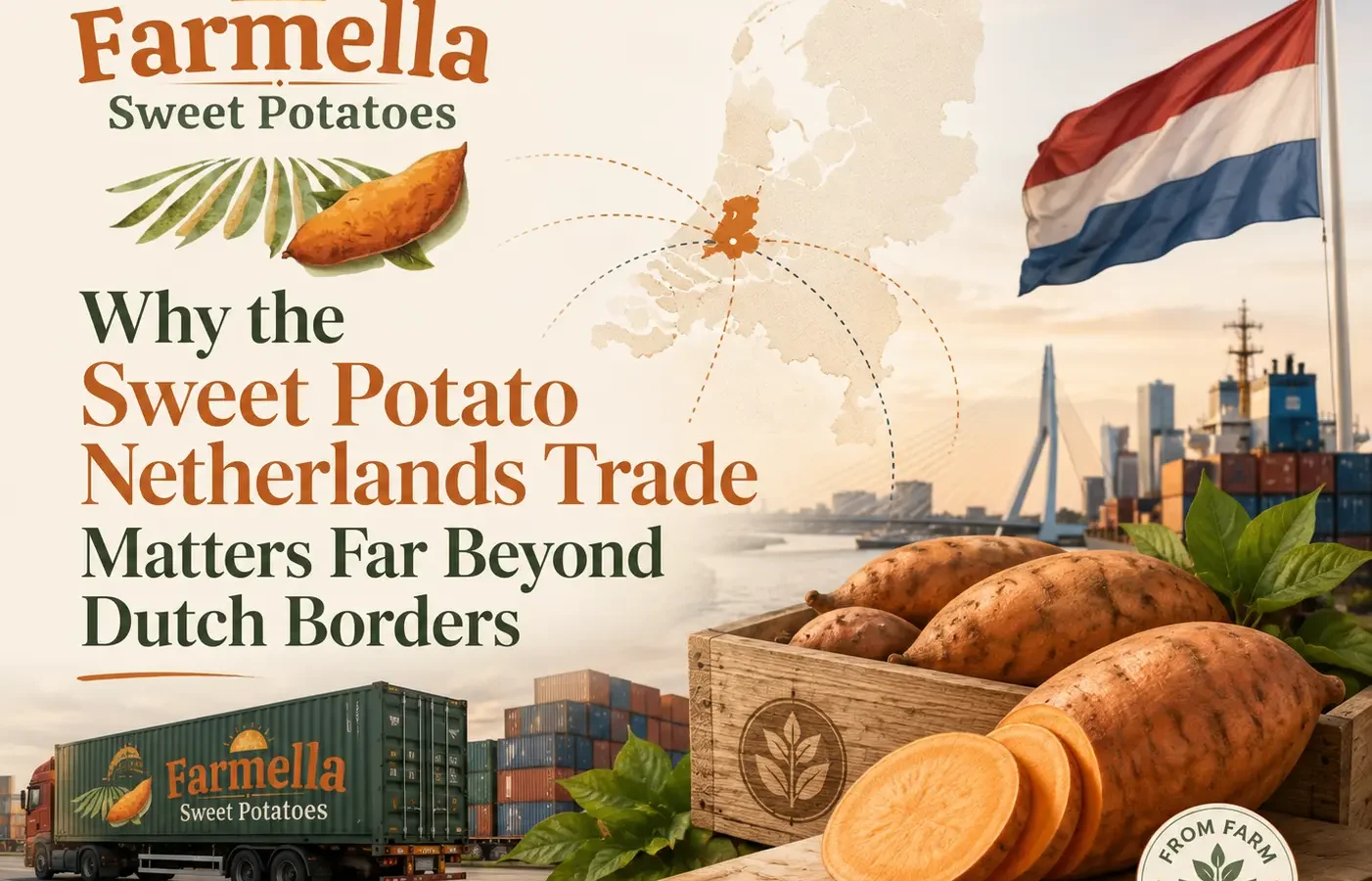
When people think about the European sweet potato trade, the Netherlands often appears as just another destination. In reality, it plays a much bigger role. The sweet potato Netherlands market has become one of Europe’s most important trading and distribution hubs, connecting exporters with retailers, wholesalers, and food-service businesses across the continent.
For suppliers, understanding the Dutch market isn’t simply about selling to one country, it’s about accessing wider European opportunities. As sweet potato import Netherlands continues to support year-round availability, buyers are placing greater emphasis on consistency, quality, and reliable supply chains.
In this blog, we’ll explore:
- Why the Netherlands is a strategic gateway for European trade
- How sweet potato import trends are reshaping buyer expectations
- What Dutch importers look for in international suppliers
- Why reliable exporters are becoming long-term partners, not just vendors
For Egyptian exporters, understanding how the Netherlands operates can open the door to stronger partnerships and sustainable growth across Europe, not just within Dutch borders.
Why the Sweet Potato Netherlands Market Has a Wider European Impact
The sweet potato Netherlands market is recognised as one of Europe’s most important trade centres, but its influence extends far beyond its own borders. While Dutch consumers contribute to market demand, the country’s true strength lies in connecting international producers with buyers across Europe. Thanks to its strategic location and advanced logistics infrastructure, the Netherlands has become a key destination for exporters looking to expand their reach within the European market.
The Netherlands as More Than a Consumer Market
The Netherlands is much more than a country that imports sweet potatoes for domestic consumption. This wide distribution network allows buyers to source our sweet potato products for different retail, wholesale, and food-service requirements across Europe. It serves as a commercial hub where imported produce is received, inspected, stored, and redistributed to neighbouring European markets.
This position allows Dutch importers to:
- Supply retailers and wholesalers across Europe.
- Maintain year-round product availability.
- Respond quickly to changing market demand.
- Build long-term relationships with international suppliers.
As a result, sweet potato import Netherlands plays an important role in keeping European supply chains efficient and reliable.
How Dutch Trade Connects International Farms with European Buyers
For exporters, the Netherlands offers access to far more than one national market. A single shipment can become part of a wider European distribution network, reaching buyers in several countries through established logistics channels.
This is one reason why recent sweet potato import trends continue to favour suppliers that provide consistent quality, professional grading, reliable packaging, and dependable deliveries. For Egyptian exporters, partnering with Dutch importers is not simply about exporting to the Netherlands, it’s about building a presence across Europe through one of its most strategic trading gateways.
How Sweet Potatoes Move from Dutch Ports to European Shelves
One of the biggest advantages of the sweet potato Netherlands market is what happens after a shipment arrives. The Netherlands is home to one of Europe’s most advanced logistics networks, allowing imported sweet potatoes to move quickly and efficiently from ports to businesses across the continent. This well-organized supply chain is one reason why sweet potato import Netherlands continues to play such an important role in European trade.
What Happens After Sweet Potatoes Arrive in the Netherlands
Once shipments reach Dutch ports, they go through a carefully managed process before entering the market. Depending on the buyer’s requirements, sweet potatoes may be:
- Inspected for quality and food safety.
- Sorted by size and appearance.
- Prepared for storage or immediate distribution.
- Repacked to match customer specifications.
Professional sweet potato export services help coordinate product preparation, documentation, shipping, and communication before shipments enter the Dutch distribution network.
The Role of Warehousing, Grading, and Redistribution
Modern warehousing facilities help preserve product freshness while professional grading ensures buyers receive consistent quality. After preparation, shipments are redistributed through efficient transport networks that serve markets throughout Europe, supporting current sweet potato import trends toward reliability and uniformity.
Which European Buyers Depend on Dutch Supply Networks
Dutch distribution reaches a wide range of commercial customers, including:
- Supermarket chains
- Fresh produce wholesalers
- Food-service distributors
- Hospitality businesses
- Food manufacturers
For Egyptian exporters, partnering with Dutch importers offers more than access to one country, it provides a strategic route into multiple European markets through a single, highly connected trade hub.
Why Sweet Potato Import Netherlands Demand Goes Beyond Local Consumption
At first glance, the volume of sweet potato import Netherlands may seem larger than domestic demand alone would require. That’s because a significant share of imported sweet potatoes doesn’t remain in the country. Instead, the Netherlands acts as a distribution centre, helping move fresh produce efficiently to markets throughout Europe. This role has become even more important as sweet potato import trends continue to favour reliable regional supply networks.
The Difference Between Domestic Demand and Re-Export Activity
Unlike a traditional consumer market, the Netherlands imports sweet potatoes for two main purposes:
- Meeting local retail and food-service demand.
- Redistributing products to buyers across Europe.
This dual role allows importers to manage larger volumes while creating efficient trade routes for international suppliers.
How Dutch Importers Supply Retailers Across Europe
After grading and packaging, shipments are dispatched to supermarkets, wholesalers, and food distributors in neighbouring countries. Commercial varieties such as Bellevue sweet potatoes can support these channels by offering the consistency and presentation required for wider European distribution. Established logistics networks help maintain product quality while ensuring buyers receive consistent deliveries throughout the year.
Why Suppliers Should View the Netherlands as a Regional Opportunity
For exporters, the sweet potato Netherlands market represents far more than a single destination. Building relationships with Dutch importers can provide access to multiple European markets through one commercial partnership, making the Netherlands an ideal entry point for suppliers seeking long-term growth across the region.
Sweet Potato Import Trends Reshaping Dutch Trade
The Dutch market has evolved significantly over the past few years. While price remains an important factor, today’s buyers are placing greater value on consistency, quality, and dependable supply. As a result, sweet potato import trends are influencing not only what importers purchase, but also how they evaluate international suppliers.
The Move Toward Consistent, Premium-Quality Crops
Dutch buyers increasingly look for sweet potatoes that deliver a consistent experience from one shipment to the next. Rather than focusing on volume alone, they prioritize produce that meets commercial standards every time.
Key expectations include:
- Uniform sizing and grading
- Smooth, undamaged skin
- Consistent internal quality
- Strong shelf life
- Professional packaging and presentation
Beauregard sweet potatoes are well suited to commercial programmes where buyers require an attractive appearance, dependable texture, and consistent grading across repeat shipments. Premium-quality crops help retailers reduce waste while improving customer satisfaction.
Why Reliable Seasonal Supply Is Becoming More Valuable
European buyers expect products to remain available throughout the year, even when growing seasons vary between countries. This makes suppliers who can deliver consistent seasonal volumes particularly valuable.
Reliable supply allows importers to:
- Plan inventory more effectively.
- Meet retailer contracts with confidence.
- Reduce supply interruptions.
- Build stronger long-term partnerships.
How Buyer Expectations Are Changing Supplier Selection
Today’s importers evaluate much more than price before choosing a supplier. Businesses involved in sweet potato import Netherlands increasingly seek exporters who combine high-quality products with dependable service.
Many purchasing decisions now consider:
- Consistency across multiple shipments
- Clear communication
- Accurate product specifications
- Flexible packaging options
- Reliable export coordination
For Egyptian exporters, these changing expectations create an opportunity to stand out through professionalism, consistency, and long-term value rather than competing on price alone. The sweet potato Netherlands market continues to reward suppliers who deliver both quality and reliability.
What Makes the Netherlands an Important Entry Point into Europe?
The sweet potato Netherlands market has earned its position as one of Europe’s leading trade gateways thanks to its efficient logistics and strategic location. For international exporters, this means faster access to buyers across multiple countries through a single import destination.
Strong Port, Transport, and Cold-Chain Infrastructure with Access to European Markets
The Netherlands combines world-class infrastructure with excellent regional connectivity, allowing imported sweet potatoes to move efficiently throughout Europe.
Its advantages include:
- Modern seaports handling international shipments.
- Temperature-controlled storage facilities.
- Fast road and inland transport networks.
- Direct access to major retail and wholesale markets across Europe.
This infrastructure supports the growing demand for reliable sweet potato import Netherlands operations.
How Efficient Distribution Reduces Time Between Arrival and Sale
Efficient logistics help shorten the journey from port to customer, preserving freshness and reducing handling time. These logistics also help buyers preserve important Egyptian sweet potato benefits, including freshness, dependable shelf life, and consistent commercial quality after arrival. As sweet potato import trends continue to prioritise product quality and dependable supply, faster distribution gives both importers and exporters a valuable commercial advantage while helping retailers receive fresher products with a longer selling window.
What Dutch Importers Expect from Global Sweet Potato Suppliers
Choosing a supplier is about much more than securing a competitive price. Businesses involved in sweet potato import Netherlands look for exporters who can consistently meet commercial standards while supporting smooth, long-term trade relationships.
Uniform Sizing, Appearance, and Reliable Volumes
Dutch importers expect every shipment to meet the agreed specifications, not just the first order. Consistency across multiple deliveries is essential for retailers and wholesalers that rely on predictable inventory and product quality.
Typical expectations include:
- Uniform size and shape
- Clean, healthy skin
- Accurate commercial grading
- Reliable volumes across multiple shipments
- Consistent product quality throughout the season
Meeting these standards helps suppliers align with evolving sweet potato import trends while giving buyers confidence in long-term supply.
Clear Communication and Accurate Export Documentation
Professional communication is equally important. Buyers value suppliers who provide clear product specifications, complete export documentation, and regular shipment updates. For exporters entering the sweet potato Netherlands market, transparency reduces delays, strengthens trust, and creates the foundation for lasting commercial partnerships.
Why Quality Control Matters Beyond the Dutch Border
Quality control doesn’t stop at the Dutch port. Since many shipments entering the sweet potato Netherlands market are redistributed across Europe, maintaining consistent standards is essential. A single quality issue can affect multiple customers, making quality control a shared responsibility throughout the supply chain.
How Product Quality Affects European Redistribution
Once imported, sweet potatoes may be distributed to several European markets. Consistent quality helps every buyer receive products that meet the same commercial standards.
Quality control supports:
- Uniform sizing and appearance
- Longer shelf life
- Better product presentation
- Reduced waste during distribution
- Greater buyer confidence
Why One Inconsistent Shipment Can Damage Multiple Buyer Relationships
Because Dutch importers often supply several countries, one inconsistent shipment can have a wider commercial impact than many exporters realise.
It may lead to:
- Retailer complaints in multiple markets
- Product returns or rejected deliveries
- Lost confidence in future shipments
- Damage to both the importer’s and exporter’s reputation
This is why buyers place so much value on suppliers who can deliver the same quality across every shipment, not just the first one.
The Role of Sorting, Grading, and Traceability
A professional quality control process helps importers verify every shipment before products continue their journey across Europe.
These systems typically include:
- Commercial sorting by size and quality
- Accurate grading based on buyer specifications
- Product traceability throughout the supply chain
- Documented quality inspections
- Compliance with export requirements
As sweet potato import trends continue to favour dependable suppliers, these practices help exporters build stronger relationships within the sweet potato Netherlands market and beyond.
Packaging Sweet Potatoes for Dutch and European Distribution
Packaging plays a much bigger role than simply containing a product. In the sweet potato Netherlands trade, it helps protect sweet potatoes as they move through multiple handling and transport stages before reaching buyers across Europe. Well-designed sweet potato packaging solutions reduce damage, preserve freshness, and ensure products arrive in excellent condition.
Why Packaging Must Protect Products Across Multiple Supply Stages
From the packing facility to the final customer, sweet potatoes may be loaded, unloaded, stored, and transported several times. Packaging should therefore provide protection throughout the entire journey.
Effective packaging helps:
- Minimise bruising and pressure damage
- Maintain airflow around the product
- Protect appearance during transport
- Reduce losses throughout distribution
- Support longer shelf life
Choosing Formats for Wholesalers, Retailers, and Food Service
Different buyers require different packaging solutions depending on how the products will be sold or distributed.
Common packaging options include:
- Bulk cartons for wholesalers
- Retail-ready packs for supermarkets
- Larger-volume packaging for food-service businesses
- Custom packaging based on buyer specifications
Selecting the right format makes sweet potato import Netherlands more efficient while meeting the needs of different market segments.
How Packaging Supports Handling, Presentation, and Shelf Life
Good packaging does more than protect sweet potatoes, it also improves handling efficiency and product presentation. Combined with proper storage and careful transport, suitable packaging helps maintain freshness, supports current sweet potato import trends, and gives buyers greater confidence in the quality of every shipment.
Packaging Sweet Potatoes for Dutch and European Distribution
Packaging must protect sweet potatoes through several stages, from export loading and Dutch warehousing to redistribution across Europe. In the sweet potato Netherlands trade, weak packaging can lead to bruising, moisture loss, poor presentation, and shorter shelf life.
Protecting Quality, Handling, and Shelf Life
Suitable packaging should:
- Reduce movement and pressure damage
- Allow enough ventilation
- Support safe stacking and handling
- Preserve freshness and appearance
- Withstand repeated transport stages
This protection is especially important when shipments are redistributed to more than one European market.
Choosing Formats for Different Buyers
Packaging should also match how each buyer sells or uses the product:
- Bulk cartons for wholesalers
- Retail-ready packs for supermarkets
- Larger formats for food-service buyers
- Custom weights based on buyer specifications
For sweet potato import Netherlands, the right format improves handling, presentation, and product performance from arrival to final sale.
How Sweet Potato Import Trends Influence Pricing and Contracts
Pricing in the sweet potato Netherlands market depends on far more than the cost per carton. As sweet potato import trends evolve, buyers are placing greater value on suppliers who can deliver consistent quality and dependable service throughout the season.
Why Buyers Evaluate More Than the Lowest Price
A competitive price is important, but it is only one part of the decision. Importers also consider:
- Product quality and uniformity
- Shelf life after arrival
- Reliability of deliveries
- Packaging quality
- Supplier communication and support
A lower-priced shipment can become more expensive if quality problems lead to waste or customer complaints.
The Impact of Seasonality and Long-Term Supply Agreements
Seasonal availability, harvest timing, and product quality all influence market pricing. Rather than negotiating one shipment at a time, many buyers prefer long-term supply agreements that secure reliable volumes throughout the season. These partnerships reduce supply uncertainty, simplify planning, and create greater value for both importers and exporters involved in sweet potato import Netherlands.
The Risks Suppliers Must Manage When Entering the Dutch Market
Entering the sweet potato Netherlands market offers significant opportunities, but it also requires suppliers to meet high commercial standards. Even small mistakes can affect buyer confidence and reduce the chances of securing repeat business.
Common Risks That Can Affect Export Success
Dutch importers expect consistency in every order. Suppliers should avoid:
- Inconsistent quality across large commercial shipments
- Delays caused by transport or logistics disruptions
- Incomplete or inaccurate export documentation
- Products that do not match the agreed size or grading
- Packaging that differs from buyer specifications
A single issue can delay distribution across several European markets and increase costs for both the importer and the exporter.
Why Meeting Buyer Specifications Matters
Successful exporters pay close attention to every commercial requirement before shipping. Product consistency also begins at the growing stage, where the Nile Delta soil advantages help support healthy root development and reliable commercial sizing before sorting and export preparation begin. Accurate grading, reliable documentation, and on-time deliveries help build trust and reduce unnecessary risks. For suppliers entering sweet potato import Netherlands, consistently meeting buyer specifications is one of the most effective ways to establish long-term partnerships and remain competitive in a demanding European market.
Why Egyptian Sweet Potatoes Fit the Netherlands’ Trade Model
Egypt has become an increasingly reliable supplier for European markets by combining favourable growing conditions with strong export capabilities. For businesses involved in sweet potato import Netherlands, Egyptian sweet potatoes offer the consistency and flexibility needed to support year-round trade.
This supply strength is rooted in the Egyptian sweet potato heritage, which combines long-standing agricultural knowledge with modern grading, packaging, and export practices.
Seasonal Supply and Strong Storage Performance
Egyptian sweet potatoes help importers maintain supply when market demand remains strong.
Key advantages include:
- Seasonal availability that complements European supply
- Excellent storage performance during transport
- Strong shelf life after arrival
- Consistent quality across commercial shipments
These strengths allow Dutch importers to redistribute products confidently throughout Europe.
How Egyptian Export Experience Supports Dutch Importers
Experienced Egyptian exporters understand the requirements of European buyers. They provide:
- Professional grading and sorting
- Reliable shipment volumes
- Export documentation that meets international standards
- Packaging tailored to different market needs
By combining dependable supply with export expertise, Egyptian producers have become valuable partners within the sweet potato Netherlands market, helping importers respond to changing sweet potato import trends while serving customers across Europe.
How Exporters Can Build Stronger Relationships with Dutch Buyers
Long-term success in the sweet potato Netherlands market depends on trust, consistency, and clear commercial planning. Dutch buyers want suppliers who understand their requirements and can support repeat business, not just one successful shipment.
Providing Clear Samples, Grades, and Specifications
Before confirming an order, exporters should provide:
- Representative product samples
- Clear size and grade categories
- Accurate quality specifications
- Expected volumes and supply periods
This helps buyers compare options and avoid misunderstandings.
Maintaining Quality Across Repeat Orders
The real test begins after the first shipment. Buyers expect the same size, appearance, freshness, and quality across every repeat order.
Consistency strengthens confidence and makes future purchasing decisions easier.
Supporting Flexible Packaging and Supply Planning
Exporters can add more value by adapting to buyer needs through:
- Different pack sizes
- Retail or wholesale formats
- Flexible shipment schedules
- Seasonal volume planning
For sweet potato import Netherlands, this level of support can turn a basic supplier relationship into a reliable long-term partnership.
Why Choose Farm Sweet for the Sweet Potato Netherlands Market?
Farm Sweet supports Dutch importers with Egyptian sweet potatoes prepared for both local sales and wider European distribution. Our approach combines export-ready quality with the flexibility required by the sweet potato Netherlands market.
Export Quality from Sorting to Packaging
Every shipment is carefully prepared through:
- Professional sorting and commercial grading
- Consistent quality-control inspections
- Flexible retail, wholesale, and food-service packaging
- Product specifications tailored to buyer requirements
This helps sweet potatoes maintain their quality across different distribution channels.
Reliable Supply and Long-Term Export Support
Farm Sweet also coordinates seasonal volumes, documentation, packaging, and shipping to support smoother sweet potato import Netherlands operations.
Rather than focusing on a single order, we work to maintain consistent quality and reliable supply across repeat shipments. This long-term approach gives Dutch and European importers greater confidence when planning purchases, serving multiple markets, and building dependable supply relationships.
To discuss available varieties, seasonal volumes, packaging formats, or shipment requirements, Contact our Farm Sweet team.
Final Thoughts: Why Dutch Sweet Potato Trade Decisions Reach Across Europe
The sweet potato Netherlands market influences far more than local availability. Because Dutch importers supply buyers across several European countries, each purchasing decision can affect product access, pricing, and supply continuity throughout the region.
Dutch Imports and Wider European Availability
Efficient redistribution allows imported sweet potatoes to reach:
- Supermarkets
- Wholesale markets
- Food-service distributors
- Retailers in neighbouring countries
This is why reliable suppliers often gain access to more than one market through a single Dutch partnership.
How Quality and Consistency Create Long-Term Opportunities
Importers need suppliers who can deliver the same standards across repeat shipments. Consistent grading, dependable volumes, suitable packaging, and clear communication all help build buyer confidence.
As sweet potato import trends continue to favour stable, long-term relationships, exporters that combine quality with reliability are better positioned to grow beyond the Netherlands and become trusted partners across Europe.
FAQs: What Suppliers Should Know About the Sweet Potato Netherlands Trade
- Why is the Netherlands important to the European sweet potato market?
The Netherlands is a major import and distribution hub, allowing sweet potatoes to move efficiently from international suppliers to buyers across Europe.
- Does the Netherlands import sweet potatoes only for local consumption?
No. Part of the imported supply may be stored, graded, repacked, or redistributed to retailers and wholesalers in other European countries.
- What do Dutch importers expect from sweet potato suppliers?
They typically expect consistent quality, accurate sizing, reliable volumes, strong shelf life, suitable packaging, and complete export documentation.
- What sweet potato import trends are influencing the Dutch market?
Important trends include stronger demand for premium quality, traceability, reliable seasonal supply, flexible packaging, and long-term supplier relationships.
- Why can the Dutch market create opportunities beyond the Netherlands?
Working with Dutch importers can give suppliers indirect access to wider European distribution networks, including retail, wholesale, and food-service markets.